cdi electronics troubleshooting guide
CDI Electronics Troubleshooting Guide: An Overview
CDI electronics troubleshooting is vital for small engine repair, especially outboards and inboards; guides, catalogs, and videos aid in circuit diagnosis and stator checks.
Effective troubleshooting involves verifying power supply, testing signals, and addressing grounding issues, alongside utilizing tools like DVAs and oscilloscopes for advanced analysis.
Understanding CDI Systems
CDI (Capacitive Discharge Ignition) systems represent a significant advancement in ignition technology, widely utilized in marine and small engine applications. Unlike traditional point-based systems, CDI relies on a capacitor to store energy and deliver a high-voltage spark, enhancing reliability and performance.
These systems consist of key components: the CDI unit itself, the stator, the ignition coil, the trigger coil (or pickup coil), and the spark plug. The stator generates a voltage that charges the capacitor within the CDI unit. When the trigger coil senses the engine’s position, it discharges the capacitor through the ignition coil, creating the spark.
Understanding this fundamental process is crucial for effective CDI electronics troubleshooting. Issues can arise from any component, impacting engine starting, running, or overall efficiency. Proper diagnosis requires a systematic approach, utilizing tools to test each element and identify the root cause of the problem.
What is a CDI Unit?
The CDI unit is the brain of a Capacitive Discharge Ignition system, responsible for controlling the timing and intensity of the spark delivered to the spark plug. It’s a self-contained electronic module that takes a low-voltage signal from the stator and transforms it into a high-voltage pulse.
Internally, the CDI unit houses a capacitor, resistors, and semiconductors. The stator charges the capacitor, and when triggered by the pickup coil, the unit discharges this stored energy through the ignition coil. This process creates the powerful spark needed for combustion.
CDI electronics troubleshooting often focuses on this unit, as it’s a common point of failure. Symptoms of a faulty CDI can include no spark, intermittent spark, or difficulty starting. Replacement units are readily available from CDI Electronics, but accurate diagnosis is key before replacement.
Common Symptoms of CDI Failure
Recognizing CDI failure symptoms is crucial for effective CDI electronics troubleshooting. The most common indicator is a “no spark” condition, meaning the engine won’t start due to the absence of ignition. Intermittent spark, where the spark is weak or inconsistent, is another frequent sign.
Difficulty starting, especially when the engine is warm, can also point to a failing CDI unit. This is because the unit’s components may become less efficient at higher temperatures. Additionally, engine misfires, rough idling, and a noticeable loss of power during operation can all be attributed to CDI issues.
However, these symptoms can overlap with other problems, so proper diagnosis using tools like a spark tester and multimeter is essential before assuming CDI failure. Always verify the basics before focusing solely on the CDI unit.
Essential Tools for Troubleshooting
CDI electronics troubleshooting demands specific tools: multimeters for voltage checks, spark testers to confirm ignition, and compression testers to assess engine health—vital for accurate diagnosis.
Multimeter Usage
A multimeter is indispensable for CDI electronics troubleshooting, enabling precise voltage measurements across various components. Begin by verifying the battery voltage, ensuring it falls within the manufacturer’s specified range. Subsequently, check the stator output voltage, comparing readings against the service manual’s values to identify potential weaknesses.
Furthermore, utilize the multimeter to test the regulator/rectifier, confirming proper voltage regulation and preventing overcharging. Inspect the CDI unit’s power supply, verifying consistent voltage delivery. When analyzing signals, a multimeter can detect continuity issues or shorts within the ignition coil and trigger coil circuits.
Remember to always observe proper safety precautions when working with electrical systems, and consult the service manual for specific voltage specifications and testing procedures. Accurate multimeter readings are foundational for effective diagnosis.
Spark Tester Application
The spark tester is a crucial tool in CDI electronics troubleshooting, directly assessing the ignition system’s ability to generate a spark. Connect the tester between the spark plug and the ignition coil, grounding the tester properly to the engine block. A strong, consistent blue spark indicates a functioning ignition circuit, while a weak or absent spark points to potential issues.
If no spark is present, systematically investigate the components upstream – the CDI unit, trigger coil, and stator. A spark tester helps isolate whether the problem lies within the high-voltage side of the ignition system or elsewhere. Remember to test each cylinder individually to pinpoint specific coil or plug failures.
Always exercise caution when working with high-voltage components, and ensure the engine is switched off during testing. A reliable spark is fundamental for combustion, making the spark tester an essential diagnostic aid.
Compression Tester Importance
While focused on CDI electronics troubleshooting, neglecting mechanical engine health can lead to misdiagnosis. A compression tester verifies the integrity of the engine’s cylinders, pistons, and valves. Low compression indicates potential issues like worn rings, leaky valves, or a damaged cylinder head, which can mimic ignition problems.
Before diving into electrical diagnostics, perform a compression test to rule out mechanical faults. Consistently low readings across all cylinders suggest a general engine wear issue, while a single low reading points to a localized problem. This prevents chasing electrical gremlins when the root cause is mechanical.
Proper compression is fundamental for combustion; without it, even a perfect ignition system won’t run the engine effectively. Therefore, a compression test is a vital preliminary step in any troubleshooting process.

Troubleshooting Ignition System Issues
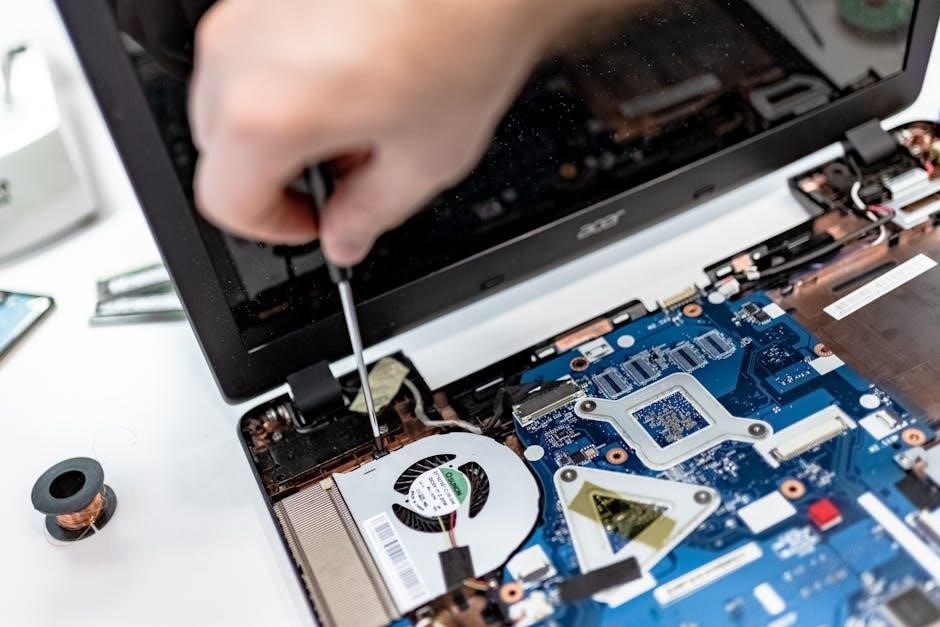
Begin with the spark plug, then test the ignition coil and analyze the stator; inspect the trigger coil for faults to pinpoint ignition failures.
Checking the Spark Plug
A fundamental step in ignition troubleshooting is a thorough spark plug inspection. Begin by disconnecting the spark plug wire, ensuring safety. Remove the spark plug and visually assess its condition – look for signs of fouling, wear, or damage to the electrode. A properly functioning spark plug should exhibit a clean, light tan or gray color.
Next, test for spark. Reconnect the spark plug to the wire, ground the plug’s metal body against the engine block, and crank the engine. A strong, consistent blue spark indicates a healthy ignition system. A weak, intermittent, or absent spark suggests a problem within the ignition components. If no spark is present, proceed to test the ignition coil and other related parts. Remember to always use caution when working with electrical components.
Ensure the spark plug gap is correct according to the engine manufacturer’s specifications. An incorrect gap can significantly impact engine performance.
Testing the Ignition Coil
The ignition coil is crucial for transforming low voltage from the CDI unit into the high voltage needed for spark. Begin by disconnecting the coil from the CDI unit and the spark plug. Using a multimeter set to measure resistance (ohms), check the primary and secondary windings of the coil. Compare the readings to the manufacturer’s specifications; deviations indicate a faulty coil.
A spark tester can also be employed. Connect the tester between the coil and ground, then crank the engine. A strong, consistent spark at the tester confirms coil functionality. A weak or absent spark points to a failing coil.
Inspect the coil for any physical damage, such as cracks or burnt spots. Replace the coil if resistance values are out of spec or if the spark test fails. Always ensure proper grounding during testing.
Analyzing the Stator
The stator generates the electrical power necessary for the CDI unit and charging system. Begin by visually inspecting the stator for any signs of damage, such as burnt wires or cracked epoxy. Use a multimeter to check the stator’s resistance, comparing readings to the manufacturer’s specifications. Deviations suggest internal winding issues.
Measure the stator’s output voltage while cranking the engine. A healthy stator should produce a consistent AC voltage. Utilize a Digital Voltage Analysis (DVA) tool to assess the stator’s waveform; abnormalities indicate potential problems.
Ensure proper connections and grounding of the stator. A faulty stator can cause a no-spark condition or charging system failures. Replacement is necessary if readings are outside acceptable ranges.
Inspecting the Trigger/Pickup Coil
The trigger coil, or pickup coil, sends a signal to the CDI unit, initiating the spark. Begin by visually inspecting the coil for cracks, breaks, or damaged wiring. Check the air gap between the coil and the flywheel; incorrect spacing drastically affects performance.
Use a multimeter to measure the coil’s resistance. Compare the reading to the manufacturer’s specifications – significant deviations indicate a faulty coil. Inspect the anti-reverse spring around the crankshaft, ensuring it isn’t shorting the sensor pickup.
A DVA (Digital Voltage Analysis) can reveal waveform distortions, pinpointing issues. A failing trigger coil often results in intermittent spark or a complete no-spark condition. Replacement is often the most effective solution.
Diagnosing Charging System Problems
Charging issues often involve the regulator/rectifier, battery, or stator; testing voltage output and checking for proper function are crucial for diagnosis and repair.
Regulator/Rectifier Testing
The regulator/rectifier is a critical component in the charging system, converting AC voltage from the stator to DC voltage for charging the battery and powering the electrical system. A faulty regulator/rectifier can lead to overcharging, undercharging, or no charging at all.
Testing begins with a visual inspection for burnt components or corrosion. Using a multimeter, check the input voltage from the stator to the regulator/rectifier. Then, verify the output voltage going to the battery – it should be around 13.5-14.5 volts with the engine running.
Further testing involves checking for shorts to ground and open circuits within the regulator/rectifier itself. Disconnect the battery before performing continuity tests. If the regulator/rectifier fails these tests, replacement is necessary to restore proper charging function and prevent damage to other electrical components.
Battery Voltage Checks
Accurate battery voltage checks are fundamental to diagnosing charging system issues. Begin with a static voltage test using a multimeter; a fully charged 12-volt battery should read approximately 12.6 volts or higher. A reading below 12.4 volts indicates a partially discharged battery, while below 12.0 volts suggests a significantly discharged state.
Next, perform a voltage drop test while cranking the engine. Voltage should not drop below 10.5 volts during cranking. A substantial drop indicates a weak battery or a problem with the starting system.
Finally, monitor the charging voltage with the engine running. As previously mentioned, it should be between 13.5 and 14.5 volts. Consistent readings outside this range point to issues with the regulator/rectifier or stator, requiring further investigation.
Stator Output Voltage Measurement
Measuring stator output voltage is crucial for verifying the charging system’s performance. Disconnect the stator wires from the regulator/rectifier. Using a multimeter set to AC voltage, measure the voltage between the stator wires while cranking the engine. Expected values vary by engine model, so consult the service manual for specifications.
Typically, a healthy stator should produce several volts AC while cranking. Low or no output indicates a faulty stator. Also, check for voltage fluctuations or erratic readings, which can signify internal winding issues.
CDI Electronics recommends using Digital Voltage Analysis (DVA) to assess stator health, particularly for replacement stators, ensuring proper functionality and preventing further damage. Proper testing confirms the stator’s ability to generate the necessary power.

Specific CDI Unit Troubleshooting
Verify the CDI unit’s power supply, meticulously test input and output signals, and resolve any grounding problems to ensure optimal ignition system performance.
CDI Unit Power Supply Verification
Ensuring a stable power supply to the CDI unit is the foundational step in troubleshooting. Begin by confirming the battery voltage is within the manufacturer’s specified range, typically around 12-14 volts. Utilize a multimeter to check for voltage drop during cranking, indicating potential battery or wiring issues.
Next, trace the power wire leading to the CDI unit, inspecting for corrosion, loose connections, or damaged insulation. Verify the fuse protecting the CDI circuit is intact. With the ignition switched on, directly measure the voltage at the CDI unit’s power input terminal.
A lack of voltage, or a voltage significantly lower than expected, points to a problem upstream – potentially a faulty ignition switch, wiring harness, or the regulator/rectifier. Remember to consult the specific CDI unit’s wiring diagram for accurate pin identification and voltage specifications.
Signal Input and Output Testing

After verifying power, assess the signal integrity to and from the CDI unit. The trigger/pickup coil sends a signal initiating the spark; use an oscilloscope to visualize this waveform, confirming its presence and proper shape. A weak or distorted signal suggests a faulty pickup coil or air gap issue.
On the output side, test the signal sent to the ignition coil. Again, an oscilloscope is invaluable here, displaying the high-voltage pulse generated by the CDI. Absence of a pulse, or an inconsistent one, indicates a failing CDI unit.
Digital Voltage Analysis (DVA) can also be employed, checking voltage levels on the blue or green wires leading to the sensor pickup. Proper signal input and output are crucial for reliable ignition; deviations signal component failure.
Grounding Issues and Solutions
Proper grounding is paramount for CDI system function. A poor ground can cause intermittent failures or prevent the CDI from operating altogether. Inspect all ground connections – from the CDI unit to the engine block and battery negative terminal – ensuring they are clean, tight, and free of corrosion.
Pay close attention to the anti-reverse spring around the crankshaft; a compromised spring can short out the sensor pickup, creating a false ground. Verify the spring’s integrity and proper positioning. Use a multimeter to check continuity between the CDI ground and the engine block, confirming a solid connection.
Addressing grounding issues often resolves seemingly complex problems. Clean connections and a functional anti-reverse spring are essential for reliable CDI operation.
Advanced Troubleshooting Techniques
Employing DVA (Digital Voltage Analysis) and oscilloscopes reveals subtle CDI signal anomalies; inspect the anti-reverse spring for shorts, enhancing diagnostic precision.
DVA (Digital Voltage Analysis) Explained
Digital Voltage Analysis, or DVA, is a powerful diagnostic technique utilized in CDI electronics troubleshooting, particularly when assessing stator performance. It moves beyond simple voltage readings, providing a dynamic, real-time view of voltage fluctuations. This allows technicians to identify subtle variations that a standard multimeter might miss.
Specifically, DVA is crucial when evaluating a replacement CDI stator (like part 176-4796K1). Instead of merely checking for the presence of voltage, DVA reveals the waveform’s shape and amplitude. A healthy stator will exhibit a consistent, clean waveform. Irregularities, such as dips, spikes, or a distorted shape, indicate potential winding issues, shorts, or opens within the stator itself.
Using DVA helps pinpoint intermittent problems and confirms whether a component is functioning within specifications under load. It’s a proactive approach, preventing further damage and ensuring accurate repairs.
Using an Oscilloscope for CDI Signals
An oscilloscope is an invaluable tool for advanced CDI electronics troubleshooting, offering a visual representation of electrical signals. Unlike a multimeter, it displays voltage changes over time, revealing signal shape, frequency, and amplitude – critical for diagnosing complex issues.
When analyzing CDI systems, an oscilloscope helps verify the trigger coil signal, ensuring it’s clean and strong enough to initiate spark. It can also display the output waveform from the CDI unit itself, confirming proper switching and timing. Distorted waveforms, weak signals, or missing pulses indicate potential problems within the CDI module or associated components.
Furthermore, an oscilloscope allows for the examination of stator output, identifying intermittent shorts or opens. By visualizing the signals, technicians can accurately pinpoint the source of ignition failures, leading to faster and more effective repairs.
Anti-Reverse Spring Inspection
A frequently overlooked, yet crucial step in CDI electronics troubleshooting, is inspecting the anti-reverse spring located around the crankshaft. This small component prevents the engine from rotating backward, which can damage the sensor pickup and disrupt ignition timing.
A compromised or missing anti-reverse spring allows the engine to “kick back,” potentially shorting the sensor pickup coil to ground. This short can manifest as a no-spark condition or intermittent ignition failures, leading to misdiagnosis of the CDI unit or other components.
Carefully examine the spring for corrosion, breakage, or improper seating. Ensure it maintains sufficient tension to reliably prevent reverse rotation. Replacing a faulty anti-reverse spring is a simple, cost-effective repair that can resolve seemingly complex ignition problems.

Contacting CDI Electronics for Support
CDI Electronics provides direct support via Return Material Authorization (RMA) and comprehensive web resources, including support pages and detailed product information.
Their address is 353 James Record Road SW, Huntsville, AL 35824 USA.
Return Material Authorization (RMA) Process
CDI Electronics requires a Return Material Authorization (RMA) for all returned products, ensuring efficient processing and tracking of repairs or replacements. To initiate an RMA, directly contact CDI Electronics; do not return items without prior authorization.
The process typically involves providing detailed information about the failed component, including the part number, engine application, and a clear description of the observed symptoms. CDI will then evaluate the request and, if approved, issue an RMA number.
Carefully package the defective unit, clearly marking the RMA number on the outside of the shipping container. Ship the item to the address provided with the RMA instructions: CDI Electronics, 353 James Record Road SW, Huntsville, AL 35824 USA. CDI advises retaining the tracking information for your records.
Returned items are subject to inspection and testing to verify the reported failure.
Website and Web Support Resources
CDI Electronics provides extensive online resources to assist with troubleshooting and product selection. Their official website, www.cdielectronics.com, serves as a central hub for accessing detailed product catalogs, application guides, and technical documentation.
The website features a robust search function, allowing users to quickly locate parts based on engine make, model, and year. Furthermore, CDI offers cross-reference tools to identify compatible components from other manufacturers.
Web support includes instructional videos demonstrating common troubleshooting procedures, such as circuit diagnostics and stator testing. Customers can also find helpful articles addressing frequently asked questions and common ignition system issues.
For direct assistance, CDI Electronics offers online contact forms and email support, enabling users to submit inquiries and receive expert guidance from their technical team. These resources empower technicians and boat owners to effectively diagnose and resolve ignition problems.